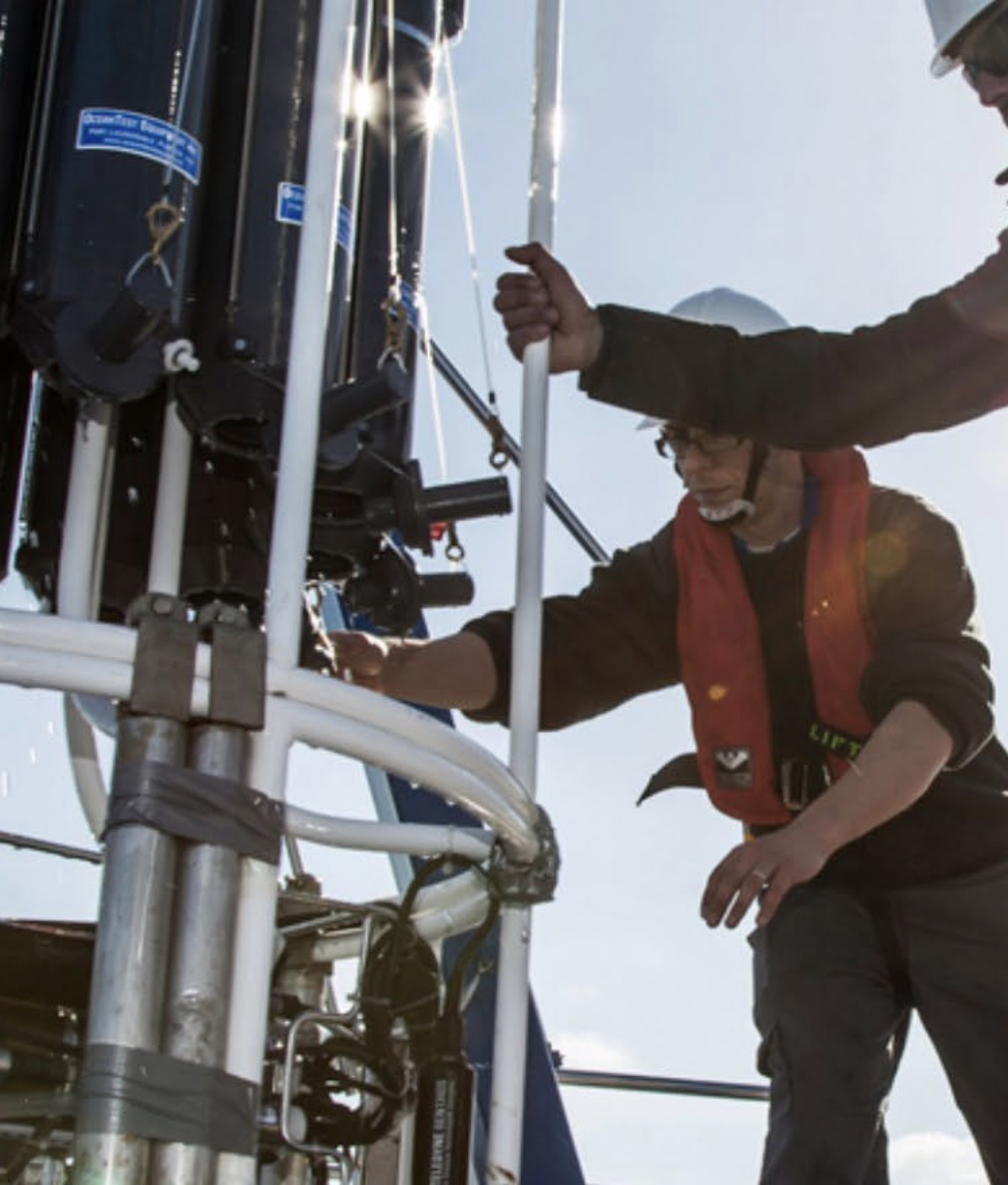
Oceanographic instruments, like any electronic equipment, require careful maintenance and have specific configurations and operating procedures, much like household appliances.
The instruments used at the SATS observatory (CTDs, gliders, the ocean-meteorological buoy, mooring instrumentation, etc.) require specific maintenance, configuration, and protocols to ensure proper operation.
CTDs CTDs mounted on the oceanographic rosette are permanently installed on research vessels. Therefore, their maintenance, configuration, and operational control are carried out by the vessel’s technical staff.
Maintenance: cleaning of sensors and pump using fresh water or specific cleaning solutions.
Configuration: depends on the sensors and parameters to be recorded, adjustable via control software.
Calibration: sensors are periodically sent to the manufacturer (every 1–2 years).
AGL Buoy The AGL buoy, as a platform integrating a large number of instruments, requires more extensive maintenance and configuration operations.
It includes multiple sensors (ADCP, temperature, fluorescence, etc.), cabling, solar panels, antennas, and power systems.
Maintenance: replacement of O-rings, application of silicone, battery replacement, data clearing.
Each sensor has its own dedicated manual.
Gliders Critical operations during glider missions depend on ballasting, a process in which the glider’s density is adjusted to match the density of the seawater at the deployment location and time.
It is also necessary to calibrate the compass, design the mission, and operate piloting tools and command systems.
Data Acquisition
Real-time
Data collected and transmitted via radio, satellite, or Wi-Fi (e.g., buoy sensors, gliders).
Autonomous
Up to 6 sensors in two sections (wet and dry): 9 L / 8 kg. Altimeter. Open-source firmware (C++) / independent Linux CPU. Compressed CSV (native format). Data download via external Ethernet cable (no need to open the vehicle).
Calibration
Sensor data are compared with analytical determinations from seawater samples collected using the CTD rosette.
If significant differences are detected: Corrections are applied following manufacturer technical guidelines.
In extreme cases, sensors are sent back to the manufacturer for calibration.
Quality Control and Data Publication
All SATS data comply with the FAIR principles, ensuring their discoverability, accessibility, interoperability, and reusability by the scientific community. These principles guarantee best practices in scientific data management.
Findable:
Data can be located after publication through unique identifiers and detailed metadata.
Accessible:
Data and/or metadata can be downloaded by researchers via their identifiers.
Interoperable:
Data and metadata are described using open standards, enabling exchange and reuse.
Reusable:
Data provenance is clearly defined, allowing reuse under established conditions.