


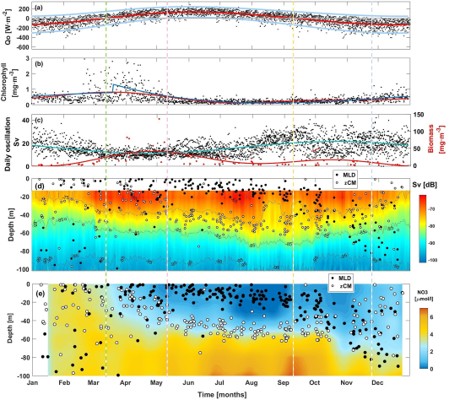
Zooplankton play a crucial role in marine ecosystems, serving as primary consumers and vital components of the marine food web. Studying the temporal dynamics and regulatory mechanisms governing zooplankton biomass is fundamental for understanding ecosystem functioning and responding to environmental changes. In this context, acoustic monitoring has emerged as a powerful tool for investigating zooplankton dynamics, offering high‐resolution spatio-temporal data with minimal disturbance to the marine environment. At open‐ocean stations, characterized by their stable environmental conditions and minimal human interference, long‐term high‐frequency acoustic observations provide valuable insights into the seasonal fluctuations and regulatory processes shaping zooplankton biomass. These observations offer a unique opportunity to unveil the complex interactions between environmental factors, biological processes, and zooplankton abundance. Using this approach, zooplankton is shown to be a rapidly responsive component of the marine ecosystem, exhibiting a strong seasonality and daily oscillations tightly linked to phytoplankton stock and its vertical distribution in relation to water column stability and air–sea forcing.