


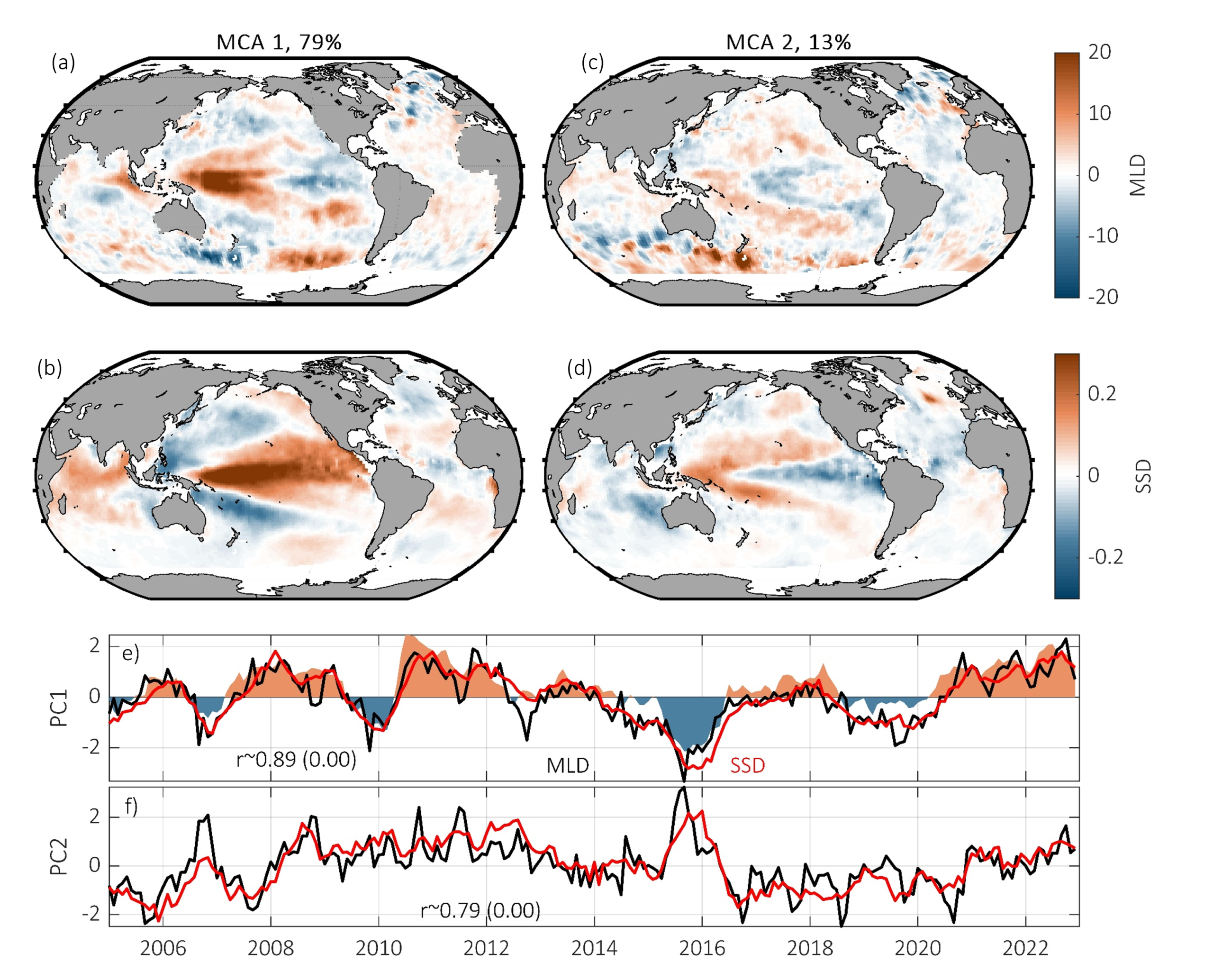
The ocean accumulates 93% of the energy in the Earth system, making it the primary regulator of climate. Besides, the global ocean not only absorbs, stores, and redistributes vast amounts of heat, but also of other climatically important properties (e.g., carbon, oxygen, and nutrients). A factor shaping this fundamental role of the ocean is stratification, which modulates the transfer of these properties between near‐surface waters and deeper oceanic layers. Yet, despite its crucial role, the variability in ocean stratification and the climatic forces influencing it remain relatively unexplored. Our work characterizes the ocean’s vertical structure in more than 2 million oceanographic profiles, and demonstrates that stratification down to depths of 1,000 m evolves with comparable spatio‐temporal scales of variability and patterns to those in the surface layer. This suggests that the ocean’s interior layers are more exposed to the influence of climatic forcings than may often have been assumed. Our results call for a view of ocean stratification from surface to
depth as a rapidly evolving, and responsive component of the climate system, with implications for global teleconnection patterns, biogeochemical cycles, marine life, and their reproducibility by Earth system models.