


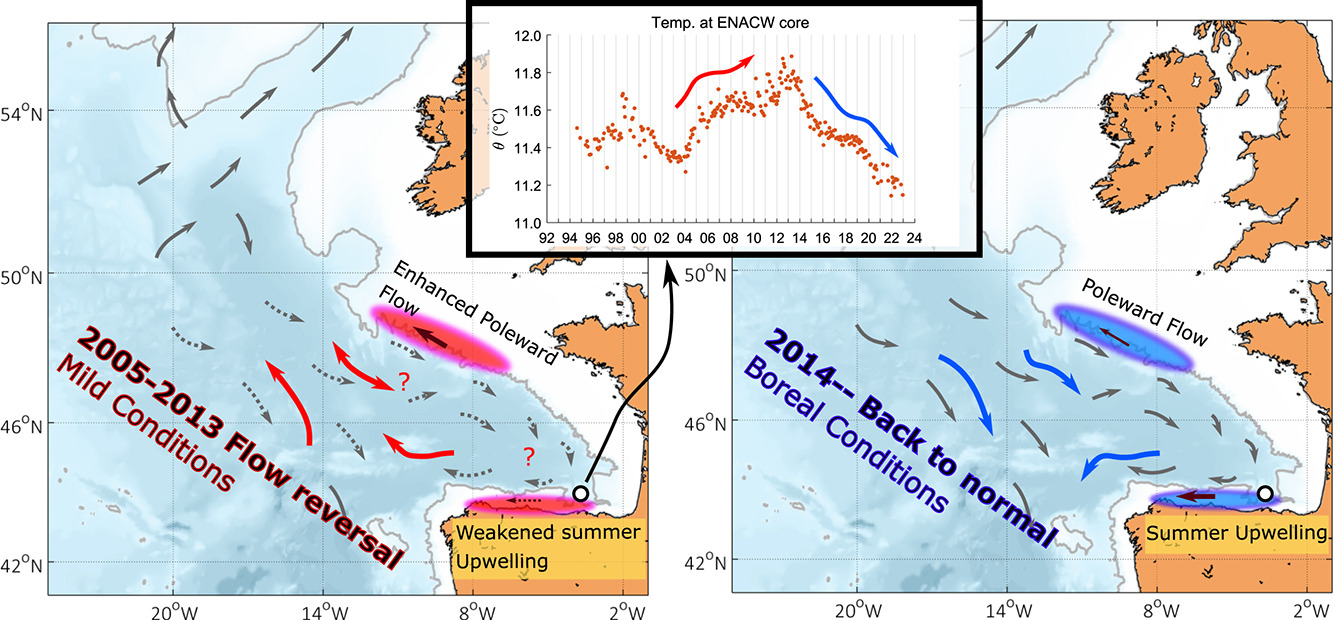
Two hydrographical shifts observed within the last two decades around north/northwestern Iberia, in the mid-latitudes of the eastern North Atlantic, reveal a contrasting behaviour of the weakly circulating reservoir known as the intergyre region. In 2005, a strong winter mixing caused an abrupt salinity increase at middepths corresponding to East North Atlantic Central Waters core levels (300–500 m), thus transforming this water mass into a saltier/denser variety. Such shift altered spatial density fields on a broader scale, causing this region classically described as flowing southwards and feeding the subtropical gyre to experience a lasting flow reversal. The reversal brought the region into milder and saltier southern-like conditions and weakened the strength of upwelling in southern Biscay. In 2014, freshening and cooling was observed for the first time since the early 1990s, a process enhanced in the following years accompanied by the restoration of southwards flow and southern Biscay upwelling conditions previously known. The decade-long reversal flow stage meant a temporal boost of ongoing meridionalisation trends attributed to climate change affecting ecosystems, while subsequent recovery to traditional circulation brought the region back to a classical more boreal character. We discuss the uniqueness or possible recurrence on larger timescales of this singular reversed mode circulation event.